Homenumental Home Infoguide From Homehearted: A Practical Workbook to Plan, Style, Budget, and Maintain Your Home
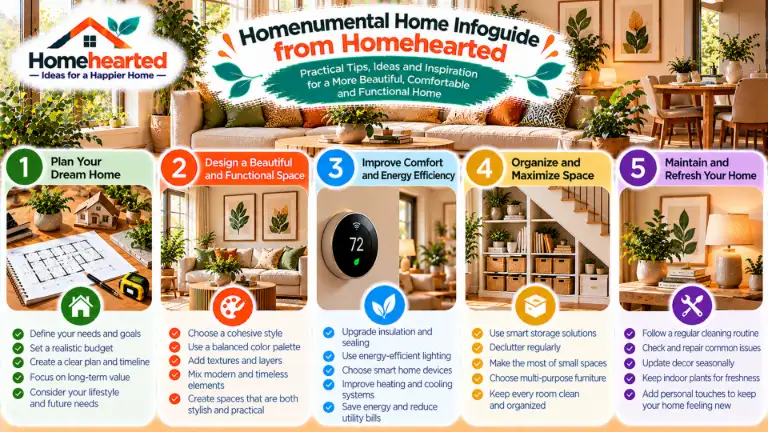
Reading about home improvement is easy. Turning it into action is harder. This workbook takes the homenumental home infoguide from homehearted and breaks it into seven practical steps you can actually complete: audit your rooms, plan renovations in the right order, set a budget, style each space, follow a maintenance calendar, build a home record, and add upgrades that pay for themselves.
Each step includes worksheets, tables, and checklists you can copy. Safety intervals and energy figures are checked against U.S. sources such as the National Fire Protection Association (NFPA), the Consumer Product Safety Commission (CPSC), the U.S. Fire Administration (USFA), ENERGY STAR, the Department of Energy, and the CDC, so you are not relying on guesswork for the details that matter most.
What Is the Homenumental Home Infoguide From Homehearted?
The homenumental home infoguide from homehearted is a home planning framework published as articles on home and lifestyle websites. “Homenumental” blends “home” and “monumental,” suggesting that small, consistent choices add up to a home that feels solid and lasting. Homehearted is the name of the home blogs that publish it.
According to those articles, Homehearted created the guide because homeowners face too much conflicting advice online and need one clear system. The pages do not name the people behind Homehearted or list professional credentials, so treat the guide as general advice and confirm safety details with official sources. This article is the hands-on workbook version. For a full explanation of the framework, its sections, and its limits, read our complete breakdown of the homenumental house infoguide by homehearted.
Home Infoguide vs House Infoguide: Are They the Same?
Mostly, yes. The homenumental home infoguide from homehearted and the “house infoguide by Homehearted” appear as titles on different pages, but they share the same core ideas: function first, a clear order of decisions, smart budgeting, and steady maintenance. The difference is emphasis. Pages titled “house infoguide” often focus on the physical building, such as systems, repairs, and buying. Pages titled “home infoguide” lean toward how a home feels and works day to day, such as styling, comfort, and routines. This workbook covers both sides.
Is There an Official Version? What We Could Verify
We found no official downloadable homenumental home infoguide from homehearted, whether as a PDF, ebook, or printed manual. The home-hearted.com page with this title, published in August 2026, is a short text article with no download. Other versions on homenumental.com, homehearted.net, and homenumental.com.co are also web articles, and their content differs. So the honest answer is that the guide is a shared framework, not a single product. Be cautious of any site that charges for an “official” version without clearly saying who wrote it.
The Core Philosophy: Warm, Mindful, and Practical Living
The homenumental home infoguide from homehearted is built on a simple philosophy: a home should feel warm, be used mindfully, and work practically every day. Five principles turn that philosophy into decisions.
Function Before Decoration
Fix what is not working before buying anything decorative. If the entry has nowhere to drop keys, a hook rack matters more than a new vase. Comfort comes from rooms that work.
Every Space Must Have a Purpose
Decide what each room is for. A dining room that doubles as a mail sorting station and a laundry pile rarely feels like a dining room. One clear purpose per room, with a secondary use if needed, keeps spaces calm.
Style Should Reflect the Homeowner
Mindful living means choosing things you value, not filling rooms to match a photo. Family pieces, books, and travel finds make a home feel personal in a way new purchases cannot.
Maintenance Matters as Much as Creation
Beautiful rooms fade quickly without care. A few minutes of upkeep each month protects your investment and keeps the home safe.
Why a System Beats a To-Do List
A list of tasks has no order and never ends, which is why the homenumental home infoguide from homehearted relies on a system instead. A system tells you what to do first, what repeats each season, and where to write it down. That is why this workbook is arranged as steps.
How the Infoguide Is Organized
The homenumental home infoguide from homehearted works best as a sequence. Here is the order this workbook follows:
| Step | Focus | What You Finish With |
| 1 | Room-by-room audit | A priority list for every room |
| 2 | Renovation sequence | A clear order of decisions |
| 3 | Budget | A spending plan with contingency |
| 4 | Styling | Seven principles applied to your rooms |
| 5 | Maintenance calendar | A seasonal and monthly routine |
| 6 | Master home document | One record of every key detail |
| 7 | Smart and energy upgrades | Lower bills and fewer surprises |
You can work through the steps over a few weekends. The first two take the least time and save the most money.
Step 1: Run a Room-by-Room Home Audit
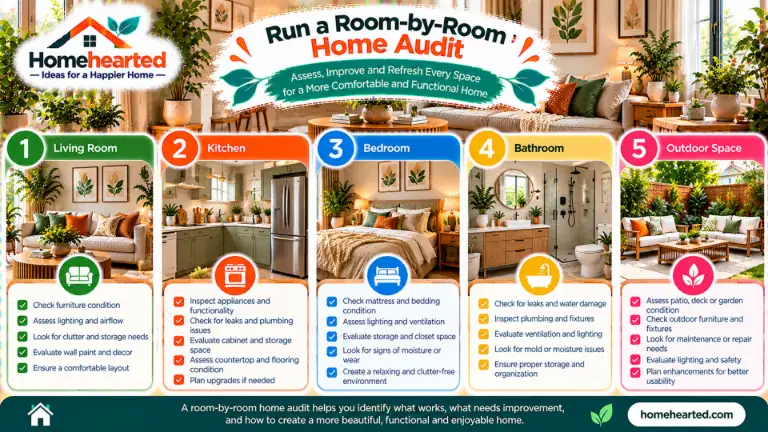
The audit is where the homenumental home infoguide from homehearted starts. Walk through every room with a notebook or your phone and record what works, what frustrates you, and what needs repair.
Start With Use, Not Style
For each room, ask three questions before thinking about colors or furniture:
- Who uses this room, and at what times of day?
- What activities happen here most?
- What gets in the way of those activities?
The answers shape everything else. A bedroom used only for sleep needs darkness and calm. A bedroom that also holds a desk needs task lighting and storage that hides work at night.
Room Priority Worksheet (Free Template)
Copy this worksheet into a spreadsheet or print it, then fill out one row per room:
| Room | Main Purpose | Biggest Frustration | Safety or Repair Issue | Quick Win | Bigger Project | Budget |
| Living room | ||||||
| Kitchen | ||||||
| Bathroom | ||||||
| Bedroom | ||||||
| Home office | ||||||
| Entryway |
Rank the rooms by urgency. Safety and water problems come first, then rooms you use most, then decorative upgrades.
Quick Wins by Room: Living Room, Kitchen, Bathroom, Bedroom, and Home Office
| Room | Quick Win | Typical Time |
| Living room | Add a second lamp at seated height to soften harsh overhead light | 30 minutes |
| Kitchen | Group items into cooking, prep, and cleanup zones | One afternoon |
| Bathroom | Replace worn caulk and add closed storage for toiletries | 1 to 2 hours |
| Bedroom | Move storage bins and laundry out of the bed’s line of sight | 1 to 2 hours |
| Home office | Bundle cables and add a desk lamp for evening work | Under an hour |
Small wins build momentum and make the larger steps of the homenumental home infoguide from homehearted feel easier.
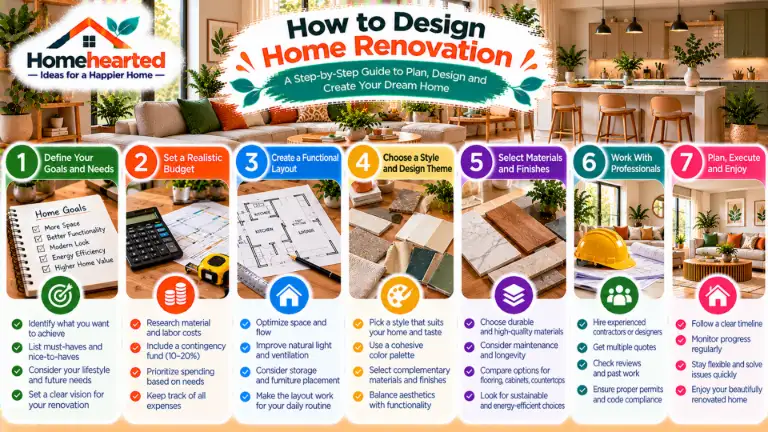
Step 2: Plan Renovations With the 5-Step Decision Sequence
Renovations cost more when decisions happen out of order. The homenumental home infoguide from homehearted uses a five-step sequence for every room:
- Function: confirm what the room must do.
- Layout: place furniture, paths, and storage on paper first.
- Lighting: plan ambient, task, and accent light, including outlets and switches.
- Color and decor: choose paint, flooring, textiles, and finishes.
- Storage: solve whatever clutter remains.
Two rules from the homenumental home infoguide from homehearted support the sequence. First, measure everything twice before ordering. Second, finish rough work such as wiring, plumbing, and drywall before finish work like paint and floors. Adding an outlet after painting means patching and painting again. When choosing materials, balance looks, durability, and cost. High-traffic floors, kitchen counters, and wet areas deserve durable materials such as porcelain tile, quartz, or quality luxury vinyl plank. Low-traffic rooms can use more delicate finishes.
Step 3: Build Your Home Budget
A budget is not just a total. In the homenumental home infoguide from homehearted, it is a plan for where money matters most.
Spend vs Save: Spend on Structure, Save on Surfaces
Spend on things that are hard or costly to change later, and save on things that are easy to swap:
| Spend On | Save On |
| Roof, foundation, and drainage | Throw pillows and blankets |
| Electrical, plumbing, and HVAC | Accessories and decor objects |
| Windows and weather sealing | Wall art and frames |
| High-traffic flooring | Seasonal decor |
| Mattresses and daily-use seating | Trend-driven finishes |
A $40 lamp you love is a smart buy. Cheap flooring in a busy kitchen that needs replacing in three years is not.
Budget-Friendly Improvements by Price Tier
| Tier | Ideas |
| Under $100 | LED bulbs, weatherstripping, caulk, cabinet knobs, cushion covers, a plant |
| Under $500 | Paint for one or two rooms, new curtains, a rug, a smart thermostat, a lighting fixture |
| Under $2,000 | New flooring in a small room, a quality sofa or mattress, built-in shelving, a vanity update |
Prices vary by region and retailer, so use these tiers as planning guides rather than quotes.
Renovation Contingency: When to Use 10% vs 15%
A contingency covers surprises like hidden water damage, old wiring, or extra delivery fees. The home-hearted.com version of the guide recommends 10% to 15%, which matches common planning advice.
- Use 10% for cosmetic work in newer homes, where few surprises hide behind walls.
- Use 15% or more for older homes, kitchens, bathrooms, and any project that opens walls or floors.
A Worked Budget Example
Imagine a $12,000 kitchen refresh in a home built in the 1980s:
| Line Item | Cost |
| Cabinet painting and new hardware | $3,500 |
| Countertops | $4,500 |
| Lighting and electrical updates | $2,000 |
| Backsplash and installation | $2,000 |
| Project subtotal | $12,000 |
| 15% contingency | $1,800 |
| Total to have available | $13,800 |
If the electrician finds outdated wiring behind the backsplash, the contingency covers it without stopping the project.
How Much to Budget for Annual Home Maintenance
The homenumental home infoguide from homehearted encourages a yearly maintenance fund. A widely used rule of thumb is to set aside 1% to 4% of your home’s value each year for maintenance and repairs. On a $350,000 home, that is $3,500 to $14,000 a year. Choose the higher end for older homes, larger homes, and harsh climates. U.S. Census Bureau American Housing Survey data for 2019 showed homeowners spent an average of about $950 on maintenance that year, but large replacements such as roofs or HVAC systems can push costs far higher in a given year. A dedicated savings account makes those years manageable.
Where to Track Your Budget
A simple spreadsheet works well. Use columns for item, estimate, actual cost, vendor, date, and warranty. Keep receipts in the same folder as your master home document from Step 6.
Step 4: Style Your Home With 7 Practical Interior Principles
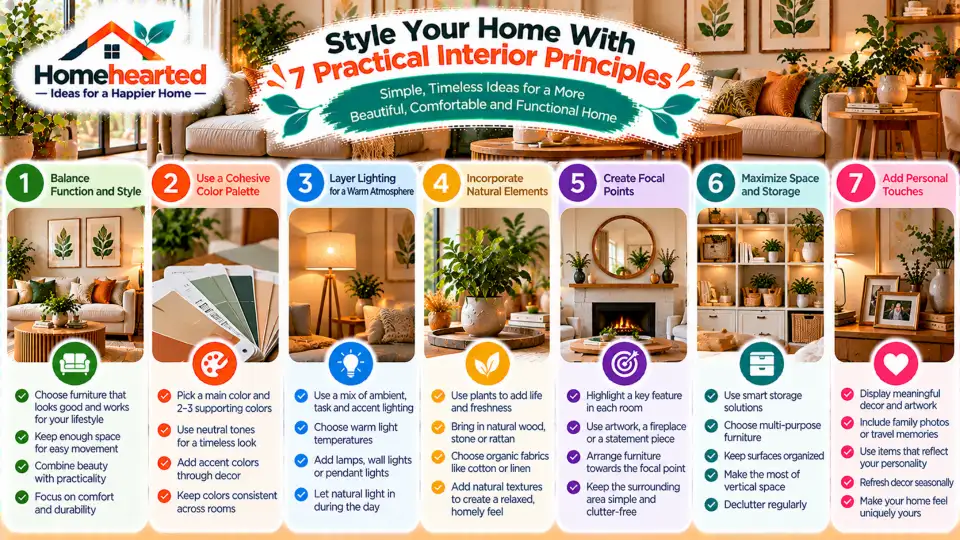
Once function and budget are settled, styling is where the homenumental home infoguide from homehearted brings in warmth. These seven principles work in almost any style, from warm minimalism to Japandi.
Establish an Inspiring Architectural Focal Point
Every room needs one place the eye lands first, such as a fireplace, a large window, built-in shelves, or a feature wall. Arrange seating to face it and keep it uncluttered.
Layer Organic Textiles and Cozy Textures
Combine natural materials like linen, wool, cotton, jute, and leather. Mix smooth and nubby textures so the room feels warm, even with a simple color palette.
Design Multilayered Warm Lighting
Use three layers of light: ambient for overall brightness, task for reading and cooking, and accent for art and plants. ENERGY STAR notes that 2700K to 3000K bulbs give the warm light of traditional incandescents, which suits living rooms and bedrooms.
Choose Sculptural Furniture and Low Tables
Rounded edges, curved sofas, and low coffee tables soften a room and keep sightlines open. Furniture on raised legs also shows more floor, which makes small rooms feel larger.
Add Statement Indoor Greenery
One or two large plants make a bigger impression than many small pots. Match each plant to the light it will receive, and choose planters that repeat a color or material from the room.
Hang Large-Scale Minimalist Artwork
A single large piece often looks more intentional than many small frames. A common designer guideline is to center art about 57 to 60 inches from the floor and choose a piece about two-thirds the width of the sofa or bed below it.
Create a Welcoming, Organized Entryway
The entry sets the tone for the whole home. Add hooks for coats, a tray for keys, a bench or shoe basket, a mirror, and a lamp so coming home feels calm instead of chaotic.
Guidelines for Decor That Lasts
- Build on neutral, durable basics and add trends in small, affordable doses.
- Choose quality over quantity for pieces you touch daily.
- Repeat one wood tone and one metal finish across the home for a cohesive look.
- Edit before adding. Remove one item for every new item you bring in.
- Pick washable and stain-resistant fabrics in busy households.
Step 5: Set Up Your Seasonal Maintenance Calendar
Maintenance is where the homenumental home infoguide from homehearted protects your budget. Adjust timing for your local climate.
Spring Checklist
- Clean gutters and confirm downspouts carry water away from the foundation.
- Look at the roof from the ground with binoculars for missing or curled shingles.
- Book an air conditioning tune-up. ENERGY STAR recommends pre-season checkups for cooling in spring and heating in fall.
- Inspect exterior caulk around windows and doors.
Summer Checklist
- Keep the AC condensate drain line clear.
- Check outdoor faucets and irrigation lines for leaks.
- Inspect deck boards, railings, and stairs.
- Watch humidity in basements and bathrooms.
Fall Checklist
- Schedule a heating system tune-up.
- Seal drafts around windows, doors, and pipe openings.
- Clean gutters after the leaves drop.
- Drain hoses and shut off outdoor faucets in freezing climates.
Winter Checklist
- Insulate exposed pipes in unheated spaces.
- Watch for ice dams along roof edges.
- Keep vents and radiators clear of furniture.
- Test the sump pump if your home has one.
To save on heating and cooling, the Department of Energy says turning your thermostat back 7 to 10 degrees Fahrenheit for 8 hours a day can save as much as 10% a year.
Monthly and Quarterly Tasks
Monthly tasks catch small problems early. Each quarter, walk around the outside of the home and look for new cracks, stains, pest activity, or loose siding.
The 9-Minute Monthly Home Health Check
| Task | Minutes |
| Press the test button on smoke and CO alarms | 2 |
| Check the HVAC filter and replace it if dirty | 1 |
| Look under sinks and around toilets for moisture | 2 |
| Test GFCI outlets with the test and reset buttons | 1 |
| Run water in rarely used sinks and showers | 1 |
| Check the fire extinguisher gauge | 1 |
| Glance at gutters and downspouts from outside | 1 |
Safety Checks: Smoke and CO Alarms, Dryer Vents
| Device | What Official Sources Say |
| Smoke alarms | NFPA: test monthly and replace at least every 10 years from the manufacture date |
| Carbon monoxide alarms | CPSC: test monthly, replace batteries annually, and install on every level and near sleeping areas |
| Dryer | USFA: clean the lint filter before and after each cycle and check the vent for damage, crushing, or blockages |
| Radon | CDC: test if your home has never been tested, and retest after major renovations |
Following these intervals is one of the simplest ways to use the homenumental home infoguide from homehearted for safety. Many fire safety experts also recommend cleaning the full dryer vent duct at least once a year, or sooner if clothes take longer to dry.
Step 6: Create Your Master Home Document
A master home document holds every important detail about your house in one place. In the homenumental home infoguide from homehearted, it is the step that saves the most time over the years.
What to Include
- Room measurements and window sizes
- Paint brands, color names, and finishes
- Appliance makes, models, serial numbers, and purchase dates
- HVAC filter size and last replacement date
- Locations of the main water shutoff, gas shutoff, and electrical panel
- Warranties, manuals, and receipts
- Contractor contacts, permits, and invoices
- Alarm installation dates and maintenance logs
- Photos of rooms and valuables for insurance
Where to Keep It: Digital vs Paper
| Option | Best For | Drawback |
| Cloud document or spreadsheet | Searching, sharing, and phone access | Needs an internet connection |
| Printed binder | Power outages and emergencies | Harder to update |
| Both | The most reliable setup | Takes slightly more effort |
Start with shutoffs and appliance labels on day one, then add one room per week.
Simple Home Organization Systems
The homenumental home infoguide from homehearted keeps organization simple. Store items close to where you use them, give everything a permanent home, and label bins. Create a landing zone by the door for keys, mail, and bags. Review storage each season and donate what you no longer use. A simple system you maintain always beats a complicated one you abandon.
Step 7: Add Smart Home and Energy Upgrades That Pay Off
Not every gadget is worth buying. The homenumental home infoguide from homehearted favors upgrades that cut costs or prevent damage:
| Upgrade | Why It Pays Off |
| LED bulbs | ENERGY STAR says certified LEDs use about 90% less energy and can last up to 25 times longer than incandescent lighting |
| Smart or programmable thermostat | Automates temperature setbacks |
| Water leak sensors | Alert you early near water heaters, washers, and sinks |
| Smart plugs and timers | Turn off lamps and devices automatically |
| Weatherstripping and caulk | Low-cost draft control |
Choose devices that work with your current platform, and store passwords and model numbers in your master home document.
2026 Design Trends Worth Using
The styling side of the homenumental home infoguide from homehearted highlights calm, natural, and lasting design:
- Warm minimalism: simple layouts softened with wood, linen, and wool
- Organic modern: natural materials, curves, and earthy colors
- Japandi: a mix of Japanese and Scandinavian simplicity
- Soft whites: Pantone named Cloud Dancer, a soft white, its 2026 Color of the Year
- Warm neutrals and fresh greens: Sherwin-Williams chose Universal Khaki for 2026 and Celery, a light yellow-green, for 2027
Use trends through paint, textiles, and accessories so they are easy to change later.
Customize the Infoguide for Your Situation
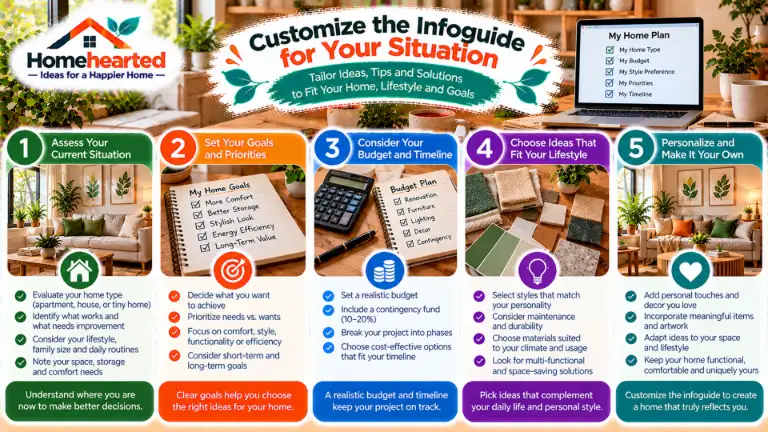
You do not need every step of the homenumental home infoguide from homehearted at once. Start with the parts that fit your situation.
If You Rent
Skip renovation sections and focus on reversible changes: removable hooks, plug-in lamps, tension rods, and rugs. Photograph each room at move-in, test the alarms, and report problems to your landlord in writing.
If You Just Bought Your First Home
Start with Step 6 and the monthly safety check before decorating. Find every shutoff, record filter sizes, and test for radon if the home has never been tested.
If You’re Renovating on a Budget
Sort projects into three groups: prevents damage, improves daily life, or is purely decorative. Fund them in that order, and protect your contingency.
If You’ve Owned Your Home for Years
Track the age of your roof, water heater, HVAC system, and alarms. Save toward replacements before they fail, and replace smoke alarms that are 10 or more years past their manufacture date.
Adjusting for Your Region and Climate
| Climate | Focus |
| Cold | Pipe insulation, ice dam prevention, early heating service |
| Hot and humid | Humidity control, clear AC drain lines, mold checks |
| Hot and dry | Frequent caulk and weatherstripping checks |
| Coastal | Rinsing salt from hardware and corrosion-resistant fasteners |
Common Mistakes to Avoid
- Decorating before fixing function. The room looks good but still frustrates you.
- Buying before measuring. Oversized furniture crowds rooms and blocks paths.
- Renovating out of order. Finish rough work before paint and floors.
- Skipping the contingency. One surprise can stall the whole project.
- Ignoring maintenance. Skipped filters and old caulk lead to bigger repairs.
- Hanging art too high or rugs too small. Both make a room feel unfinished.
- Relying on one overhead light. Layered lighting is warmer and more useful.
- Keeping no home record. Lost warranties and unknown filter sizes waste time.
Your First-Weekend Action Plan
Use this short plan to put the homenumental home infoguide from homehearted into action right away:
- Saturday morning: test every smoke and CO alarm and check the HVAC filter.
- Saturday afternoon: fill out the Room Priority Worksheet for every room.
- Sunday morning: locate and label the water shutoff, gas shutoff, and electrical panel.
- Sunday afternoon: start your master home document with appliance labels and photos.
- Sunday evening: pick one quick win and finish it.
For more room-by-room ideas on kitchens, bathrooms, and bedrooms, browse the guides at HomeRecommends.
Final Verdict: Is It Worth Using, and How Is It Different From Other Home Guides?
Yes, if you use it as a framework rather than expecting an official manual. Most home content offers inspiration photos or scattered tips. The homenumental home infoguide from homehearted is different because it puts decisions in order and connects design, budgeting, maintenance, and records in one system. It has limits. It will not design your home, manage contractors, or replace a professional inspection. But as a workbook for creating your own sanctuary, one room and one season at a time, it gives you a clear path from ideas to a home that is comfortable, safe, and easy to care for.
Frequently Asked Questions
Can beginners use it without design or construction experience?
Yes. The homenumental home infoguide from homehearted uses plain language and focuses on planning, styling, and upkeep. Leave electrical, gas, plumbing, and structural work to licensed professionals.
Is it enough for a full renovation, or just decorating?
It helps you plan a renovation, including the order of decisions, budget, contingency, and materials. It does not replace architects, contractors, permits, or inspections.
Do I need a big budget to use this guide?
No. Many steps in the homenumental home infoguide from homehearted cost nothing, such as the room audit, decision sequence, and master home document. The price tier table shows meaningful upgrades under $100.
Does the infoguide cover gardens and outdoor spaces?
Some versions briefly mention outdoor areas, such as creating zones and choosing weather-resistant materials, but the main focus is the inside of the home. Apply the same principles outdoors: decide the purpose of each area first, then add seating, lighting, and plants.